On-chain forensics
From rehearsal to laundering: anatomy of the $10 million Lighter hack
A third of the money vanished into Monero. The rest is parked in wallets anyone can watch.
When a theft makes the news, the story usually ends with how the money was taken. On a blockchain it doesn't have to. Every step is on the public record: the preparation, the theft itself, and everything the thief does afterward to turn stolen crypto into fiat that can't be traced back to him.
The November 16 theft of $10.4 million from Lighter, a perpetual futures exchange, shows the whole cycle in a single morning. There was a rehearsal of the escape route, a theft that took 33 seconds, a fast exit from a freezable stablecoin, and a laundering route that worked until it was shut. Then came improvised backups and finally a pause, with most of the money parked in wallets anyone can watch.
This post follows those steps in order. The timestamps are facts; what they suggest about the thief's thinking is our inference. It ends with where the money sits today and what is likely to happen next.
The day at a glance
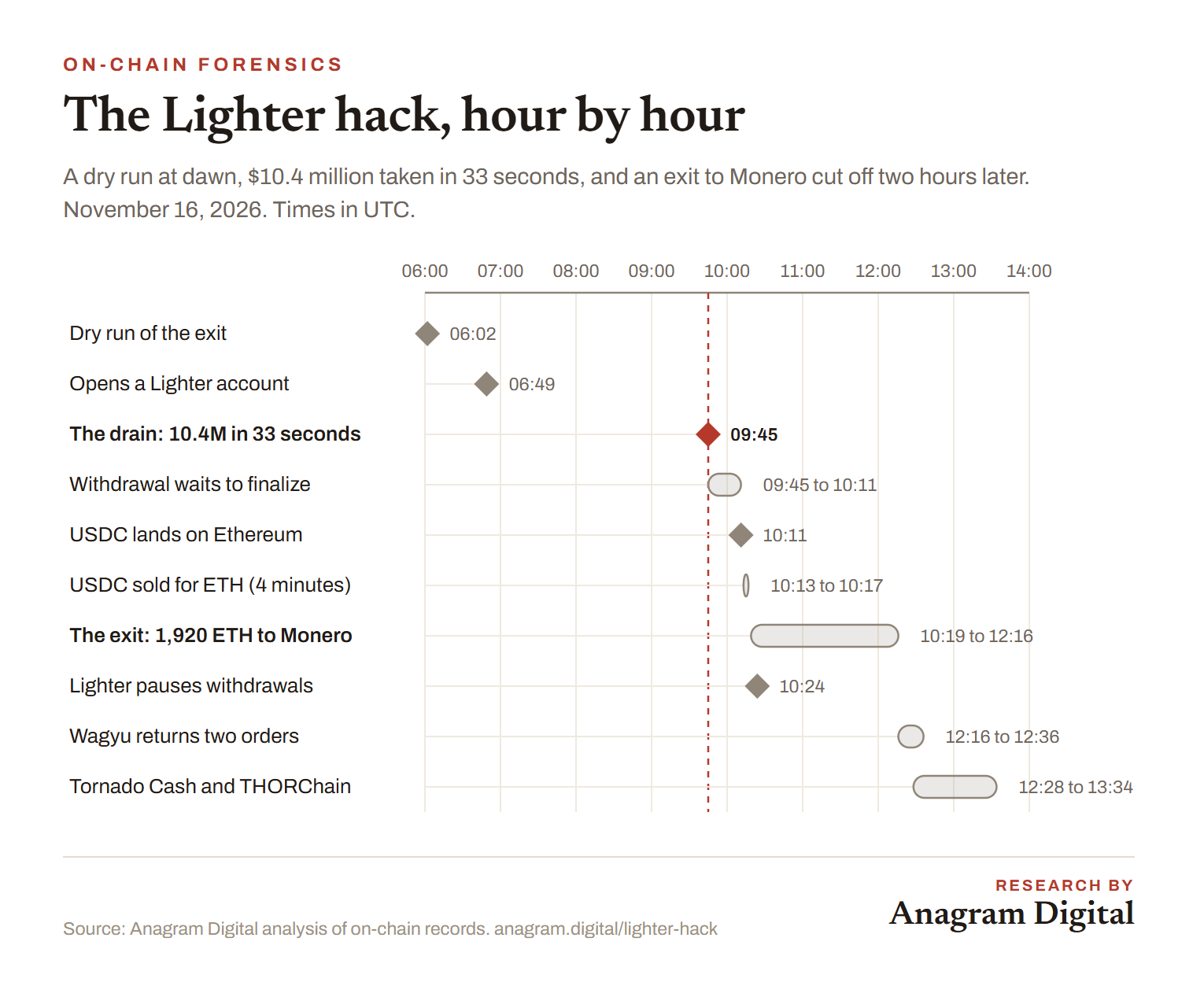
Tap the chart to open it full size.
The thief's route, step by step
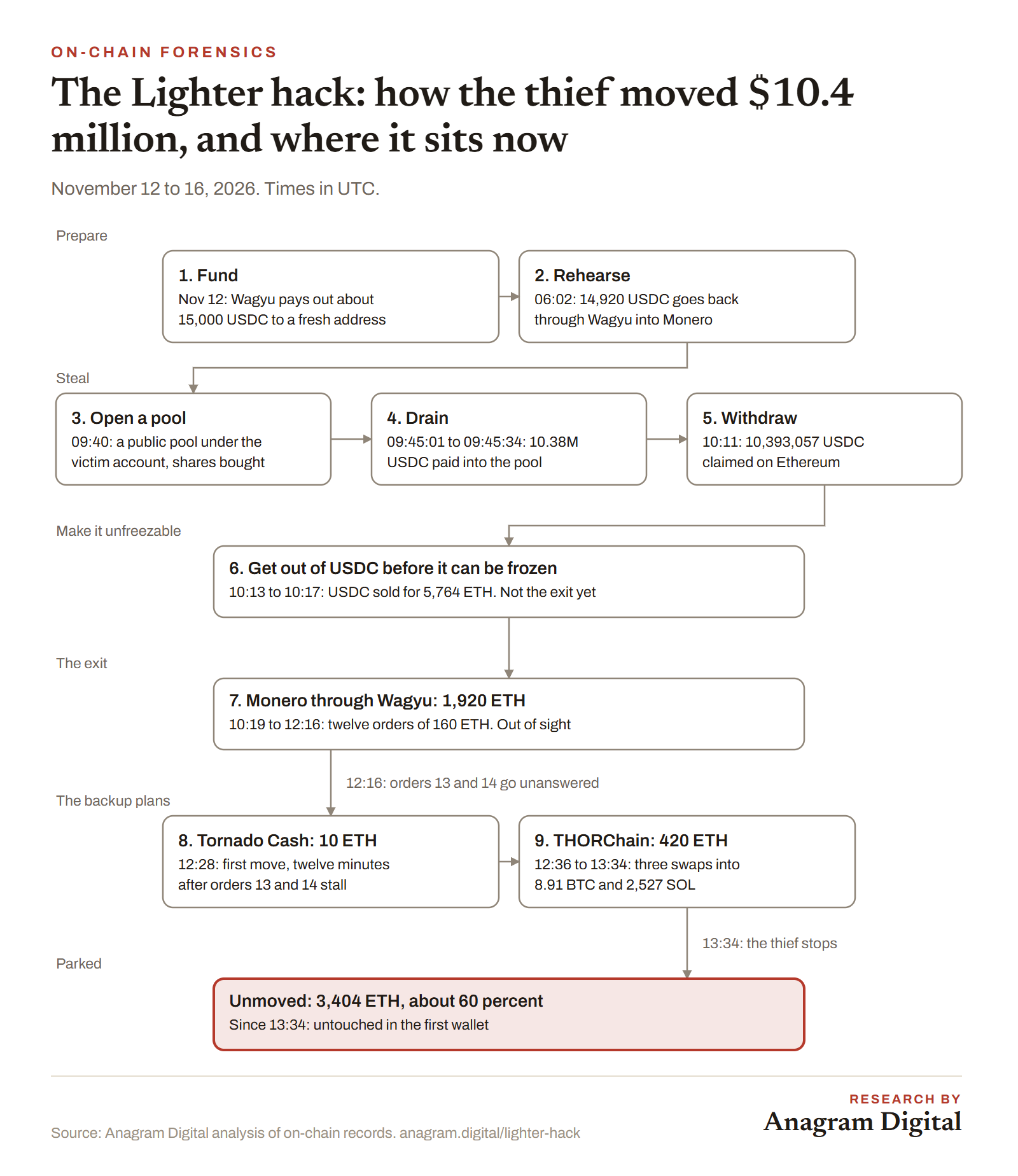
Tap the diagram to open it full size.
A flaw in the victim's own trading software handed over its key
Lighter's postmortem says the victim, a trading firm the on-chain evidence points to as Abraxas Capital, signed its orders with homemade software instead of Lighter's official tools. That software reused a number that must be fresh for every signature. Reuse it, and anyone holding two of the resulting signatures can work out the secret key behind them with simple arithmetic. Lighter's signatures were publicly visible. The thief only had to find the repeat.
The theft: $10.4 million drained in 33 seconds
The key gave the thief control of the victim's two Lighter accounts, owned by the Ethereum addresses 0x0d1D…8F6F and 0x66Cf…2068, holding $10.4 million and $5.1 million USDC respectively. With the key he could trade on both accounts and move money between the victim's own accounts, but not send it to anyone else.
He found a way around that limit. At 09:45 UTC he used a loophole in how Lighter handled public pools to move 10.38 million USDC out of the first account and into his own hands, in 33 seconds. Seconds later he directed Lighter to send it to his wallet on Ethereum. He now had two jobs, and little time for either: get the money out of USDC, which its issuer can freeze, and then move it somewhere it could no longer be traced back to the theft.
The theft on the record:
- 09:40 The thief creates a public pool under the victim's account.
- 09:45 Eleven transfers move 10.38 million USDC from the victim's account into the pool, which he then empties.
- 10:11 Lighter pays out 10,393,057 USDC to his Ethereum wallet.
Notably, he did not attempt to extract the $5.1 million from the second account, a decision that would later cost him. By the time he came back to extract these funds, Lighter had already blocked their withdrawal.
Six minutes after the money landed, it was no longer in dollars
The 10.39 million USDC reached the thief's Ethereum wallet at 10:11. His first transaction afterwards was not to hide it but to sell it. By 10:17 he had swapped 10.36 million USDC for about 5,750 ETH on CoW Swap, in a handful of large orders.
This is the first hazard of getting away with stolen crypto. USDC is a stablecoin, and its issuer, Circle, can freeze it in any wallet. So can Tether with USDT. ETH has no issuer and cannot be frozen by anyone. Every minute stolen money spends as a stablecoin is a minute in which someone can switch it off.
The Binance theft on October 29 shows what happens to a thief who cannot move fast enough. That attacker took about $3.45 billion in stablecoins. Tether froze the first wallet 37 minutes later and Circle 41 minutes later. The attacker was selling the whole time, but no market can absorb billions in under an hour, and about $2.65 billion was frozen. At $10 million, the Lighter thief was small enough for the market to take everything in minutes, and he did not waste them.
Why not avoid stablecoins altogether? Because thieves rarely get to choose. Stablecoins are what exchanges and trading venues hold, so they are what gets stolen: Lighter accounts are kept in USDC. The skill is not avoiding stablecoins but keeping the time spent holding them, in a wallet tied to the theft, as close to zero as possible.
The getaway was Monero, and he had rehearsed it that morning
Two minutes after the last sale, at 10:19, the real exit began. The thief started sending ETH, 160 at a time, to Wagyu, a swap service that needs no account and turns crypto into Monero, a currency designed to be untraceable.
This was not improvised. At 06:02 that morning, almost four hours before the theft, a wallet the thief controlled sent $14,920 through exactly the same route. It was a dry run of the getaway.
Why Monero? It has a long and successful track record for being untraceable and it is legal to hold and trade. Monero has run since 2014, and its privacy has largely held up against years of attempts to trace it. It is also an ordinary, legal asset. Anyone can hold it, some large exchanges still list it, and swap services and markets such as Hyperliquid trade it.
Once the proceeds of the hack are moved into Monero, they can easily be swapped into ETH, BTC or other mainstream cryptos with nothing tying the funds back to their source.
Waiting before going back for the second account cost him $5.1 million
The victim had a second Lighter account, and the stolen key worked there too. But the thief did not drain it right away. He waited until the first haul had reached his Ethereum wallet, then went back. At 10:27 he took another 5.1 million USDC from the second account, and at 10:28 he asked Lighter to send it out.
It was too late. Lighter had spotted the theft and, at 10:24, stopped paying out withdrawals. The second haul never left Lighter.
Had he drained both accounts back to back, both withdrawals would likely have gone through. He seems to have assumed he had more time than Lighter gave him. The wait cost him $5.1 million.
The episode also shows how protected these venues are. Lighter calls itself decentralized, but whoever runs it decides when withdrawals go out, and it used that power within about 40 minutes of the first theft.
Two hours in, the Monero door closed
At 12:16 the thief sent his thirteenth and fourteenth orders to Wagyu, 160 ETH each. Every earlier order had been picked up within two minutes. These sat untouched. Twenty minutes later, Wagyu sent both back to him.
This is where the plan broke. He had needed about six hours at the Monero market's pace and got two. About $3.4 million, a third of the haul, made it into Monero. Everything else was now an amount of ETH in a wallet the whole industry was watching, with no rehearsed way out.
He switched routes within minutes, but seemingly without much conviction
The thief noticed almost immediately. At 12:23, seven minutes after the orders stalled and before Wagyu had even sent the refunds, he was already moving 120 ETH to a fresh wallet. Within twenty minutes he had moved on to two new routes:
- Tornado Cash, a mixer that breaks the link between the coins that go in and the coins that come out. At 12:28 he put in 10 ETH, about $18,000.
- THORChain, an exchange that swaps between blockchains with no accounts at all. Between 12:36 and 13:34 he sent it 420 ETH and received 8.9 BTC and 2,527 SOL.
The speed shows he knew these tools well. He even used a little-known THORChain trick that makes each swap look like a plain transfer. These were not routes he was learning on the spot.
But look at the sizes. With more than $6 million left, he sent $18,000 to Tornado Cash and about a tenth of the rest to THORChain. He sent one Bitcoin swap, waited half an hour for it to arrive, and only then sent another. These were small transfers, which look more like tests, on routes he clearly had not planned to rely on.
Why hold back? Tornado Cash could have taken all of it, but what comes out of Tornado is still ETH, now carrying a mixer history that exchanges and analysts flag, so it needs another step before it can be spent. Even so, Tornado Cash remains widely used.
The swaps into Bitcoin likely point to the next step: a CoinJoin, a kind of mixer that blends many users' coins into shared transactions. Moving stolen funds to Bitcoin and mixing them this way is a long-established laundering route. The thieves behind this autumn's Bitget and Binance thefts both used THORChain to reach Bitcoin and then ran the coins through Wasabi Wallet's CoinJoin. But CoinJoin has the same drawback as Tornado Cash: the coins that come out are flagged as mixed, so the thief still needs a plan for spending them.
As of November 17, the stolen money sits here:
| Asset | Amount | Approx. value | Addresses |
|---|---|---|---|
| ETH | 3,414 ETH | $6.2M | 0xb3fffca2, 0x79fbfcB5 |
| BTC | 8.91 BTC | $571K | bc1qsq7p9ww76, bc1q7xwlly6j2 |
| SOL | 2,527 SOL | $187K | 6uNGcxvbtUKdo |
| Monero | from 1,920 ETH | $3.4M | Untraceable |
| Mixed in Tornado Cash | 10 ETH | $18K | Untraceable |
None of the BTC or SOL has moved since it arrived. The last two rows, in italics, are out of sight and can no longer be followed.
Then he stopped, with $6 million in plain sight
At 13:34, about three and a half hours after the theft, the thief made his last real move. As of November 17, his first wallet still holds 3,404 ETH, about $6.1 million. The Bitcoin and Solana from THORChain have not moved either.
Waiting lets attention fade and gives time to find a new route, and it is one of the most common moves after a large theft.
With every remaining wallet now watched, his options have narrowed. Any deposit at an exchange, or at a swap service that screens incoming transfers, will be flagged at once. It is not the only possibility, but if recent history is a guide, my bet is that after what may be a long wait, we will see at least a portion of the parked ETH move into Tornado Cash.
Just this year, that is what happened to the parked proceeds of the Drift (parked for about six and a half months), Pando (parked for nearly four years), and Mixin (parked for about two and a half years) hacks. After an extended period of inactivity, these hacked funds made their way into Tornado Cash.
Seconds, hours, years
The Lighter theft has run on three clocks. Taking the money took 33 seconds. Getting it out of reach had a window of about two and a half hours. Lighter froze withdrawals 40 minutes after the theft, and Wagyu began turning away his orders about two and a half hours after it. By then only a third of the money had reached Monero.
The third clock is the one running now. About $7 million in ETH, Bitcoin, and Solana sits in wallets anyone can watch, and every service that screens incoming transfers will flag them the moment they move. So thieves in his position wait, often for months and sometimes for years.
So this theft is not over. Whether it happens tomorrow or five years from now, its ending will play where all of us can see.
Method: built from Ethereum, Arbitrum, Hyperliquid, Lighter, THORChain, Bitcoin, and Solana records, the Wagyu and Relay public APIs, and our own proprietary address labeling. Balances as of November 17, 2026.
Follow the research
We publish original on-chain research like this. Leave your email and we will send new analysis when it is published. No marketing, and you can unsubscribe anytime.
Work with Anagram Digital
If you have a matter where the on-chain facts have to be right, or research you need done, tell us in a line and we reply personally. Anagram takes on bespoke engagements for counsel, financial institutions, and funds: litigation support and expert witness work, flow-of-funds tracing, custom research, and due diligence of the kind shown here. Write max@anagram.digital.